


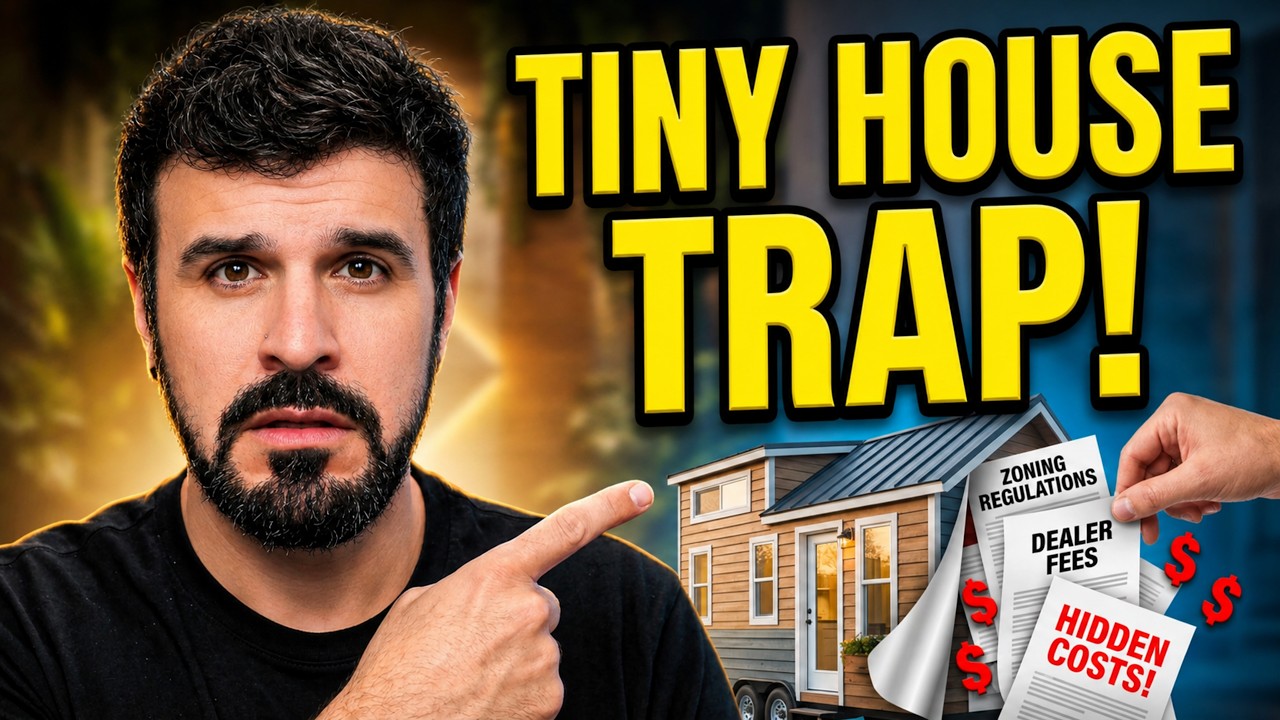
This one's a little different. Instead of a tour, this video pulls together five separate perspectives on tiny living — some critical, some cautionary, some fair, and one that opened with "don't ever move into a tiny house." It's worth watching in full, and then reading what I actually think about what each person got right.
Megan: The Five Costs Dealers Don't Mention
Megan breaks down five site costs that routinely catch first-time buyers off guard: delivery and installation, the pad, skirting, steps, and utility hookups. She's right on all of them, and the reason they catch people off guard is straightforward — dealers quote the home price, not the full project cost.
Delivery alone can run anywhere from a few hundred to a few thousand dollars depending on distance and home size. The pad — a solid, level foundation — is something a lot of first-time buyers genuinely don't factor in at all, and if it's not done correctly upfront it causes structural problems down the line. Skirting and custom steps seem like small items until you price them. Utility hookups vary enormously depending on what's already available at your site.
None of these costs should change your decision. They should just be part of the conversation from day one. Ask your dealer or builder for a full cost breakdown that includes everything outside the home itself, and you won't be surprised by any of it.
The Regret Perspective: This One Is Worth Taking Seriously
One of the clips is short — just someone saying they're exhausted, there's nowhere to put anything, they're not sure it was worth it. It's uncomfortable to watch because it's clearly real.
I want to be honest about this: it's more common than the highlight reels on social media suggest. Tiny living is not for everyone. If you genuinely need space to decompress, if you have a lot of belongings that matter to you, if you're sharing a home with someone whose daily rhythms are different from yours — it can be genuinely hard. Not impossible, but hard in ways that don't show up in the tour videos.
What I think happens is that a lot of people fall in love with the idea of tiny living without spending enough time actually inside a small space before committing. If you can stay in a tiny house on Airbnb for a week before making a decision — cook in it, work in it, sleep in it on a rainy day — do it. The romance of tiny living and the reality of tiny living are two different things, and both deserve your attention before you sign anything.
The Land and Zoning Sceptic: The Sarcasm Is Fair
One perspective takes a pointed angle on the total cost question: you buy a tiny home from a retailer, then you need land, zoning approval, power, water, sewer — and by the time you're done you've spent $100,000 to $125,000 and you still have a tiny house. The framing is sarcastic but the point underneath it is legitimate.
The land question is the one that stops people in their tracks, and it should be part of the conversation much earlier than it usually is. Where are you going to put it? Do you own the land? Is it zoned for residential use? Do you have utility access or are you planning to go off-grid? These are not small questions.
Here's where I'd push back though: that same $100,000 to $125,000 all-in — on land you own, with no mortgage or a very small one — looks very different from a 30-year mortgage on a conventional home in the current market. The comparison that matters depends entirely on your situation, your goals, and what you're comparing it to.
The Financial Investment Critique: Some of This Is Right
A financial perspective raises four concerns: depreciation, cost per square foot, utilities, and zoning. The depreciation point is accurate, particularly for tiny homes on wheels — they're classified similarly to RVs and do not appreciate the way real estate does. The cost per square foot being higher than a conventional home is also accurate. Custom small-scale building carries a premium.
On utilities, the critique overstates the off-grid assumption — many tiny homes connect to standard utilities — but the underlying point about planning ahead is fair.
On zoning, I agree completely. It is the single most underestimated challenge in tiny house living, and it needs to be researched thoroughly before a single dollar is spent. The legislative landscape is improving — Virginia, Georgia, and Florida all have significant ADU reform either in effect or in motion — but it varies enormously by location and you cannot assume your area is permissive without checking.
Where I'd offer a different lens: not everyone buying a tiny home is doing it as a financial investment. Some people are buying freedom. Some are buying the ability to own something outright without debt. Some are buying a simpler life. The financial return isn't always the point, and framing tiny living purely as an investment misses why most people choose it.
Maggie the Real Estate Agent: The Accessibility Point Is Worth Sitting With
Maggie's take covers familiar ground — expensive, hard to finance, cramped for families — but ends with a point worth taking seriously: the tiny house movement can be accessible only to a select few, and fixating on it as a lifestyle trend can obscure the broader housing affordability conversation.
She's right that tiny homes can be hard to finance through traditional lenders. She's right that the cost per square foot is high. And her final point — that the movement is sometimes only available to people who already have financial stability and land access — is a conversation the community needs to keep having honestly.
Where I Land on All of This
Everything in this video — the hidden costs, the regrets, the financial concerns, the zoning headaches — none of it is an argument against tiny living. It's an argument for going in informed.
The people who struggle in tiny homes are often the people who weren't prepared for the reality of it. The people who thrive are the ones who did the research, understood their own lifestyle honestly, got clear on the full cost picture, and made a deliberate choice. That's the only version of this that works.
This channel exists to give you the real picture — not to sell you on tiny living, not to make it look perfect — so that whatever you decide, it's your decision and you made it with clear eyes. Drop any questions in the comments below.
Join the Community
Make Your Decision With Clear Eyes
The full picture of tiny living — costs, realities, and what actually works — delivered weekly. No highlight reels, just honest information.
No spam. Just thoughtful tiny living tools.
.png)

