

Best Generators for Tiny Homes (2026 Guide)
Generators for tiny homes provide essential backup power. Our guide covers quiet inverter generators, dual-fuel options, and battery power stations for off-grid living.
Quick Answer: Our Top Picks
- Top Pick: Honda EU2200i - Super quiet at 48 dB with legendary Honda reliability.
- Dual Fuel Pick: Champion 2500-W - Runs on gas or propane for extended off-grid stays.
- Indoor Pick: EcoFlow DELTA Pro - Zero emissions, solar charging, safe to use inside.
Why Generator Choice Matters in a Tiny Home
Tiny homes concentrate sound and fumes faster than big houses. Choosing a quiet inverter or an indoor-safe battery station keeps neighbors (and you) happy. Clean power protects laptops and sensitive electronics, while dual-fuel capability stretches runtime when gas is scarce.
🔌 Wattage & Surge
Add the running watts of your essentials, then ensure enough starting watts for compressors (fridges, A/C, pumps). Soft-start kits can shrink A/C surges. Don't forget to account for small but important systems like ventilation fans for composting toilets.
⚡ Power Quality
Inverter generators and battery stations provide low-THD (Total Harmonic Distortion) clean power for electronics. Open-frame units are louder and "dirtier" but cost less per watt.
⛽ Fuel & Runtime
Gas is widely available; propane stores longer and burns cleaner; batteries are silent and solar-rechargeable. Dual-fuel units give you the best of both worlds.
🔇 Noise & Placement
Mind dB ratings and always run combustion units outdoors, downwind, with exhaust aimed away from doors and windows. Battery stations can stay safely inside.
📏 Generator Sizing Cheat Sheet
- Essentials only (lights, router, laptop, fridge): 2,000–2,500W inverter.
- Mini-split or window A/C (with soft start): 3,000–4,000W inverter.
- Whole-home style backup (well pump, big A/C): 7,500–12,000W open-frame.
- Always confirm appliance nameplate amps and starting draws; oversize slightly for comfort.
Top Generators for Tiny Homes
Honda EU2200i Super Quiet Inverter Generator

What we like: Honda's EU2200i is the benchmark for small inverter generators: compact, famously quiet, and easy on fuel. At 2200 watts peak with clean 120V output, it safely powers laptops, routers, lights, fridges with soft start, and small tools.
Other things to know: The inverter design keeps total harmonic distortion low so your sensitive electronics stay protected. Living small often means living close—neighbors, campsites, or your own sleeping loft. The EU2200i's mellow tone (48-57 dBA) makes it easier to run without disturbing the peace. The CO-Minder sensor adds an important safety backstop by shutting down if carbon monoxide accumulates.
- Class-leading noise reduction
- Legendary engine reliability
- Clean inverter power for electronics
- Higher upfront price than competitors
- 1-gallon tank requires frequent refills
- Won't start large A/C units alone
Champion 2500-W Dual Fuel Inverter

What we like: This 2500-watt Champion inverter runs on gas or propane, giving you choices during shortages and longer shelf life via LP. Expect ~1850 running watts on gas and ~1665 on propane—plenty for lights, routers, device charging, compact fridges, and many mini-splits with soft-start kits.
Other things to know: At a quoted 53 dBA from 23 feet, it's campsite-friendly and tiny-home appropriate. Trade-offs include slightly lower wattage on LP and the usual inverter premium over open-frame sets. But for portability, quiet operation, and fuel flexibility, it's a sweet spot for small spaces.
- Dual-fuel flexibility (gas/propane)
- Quiet operation (53 dBA)
- Low THD for sensitive electronics
- Lower wattage output on propane
- Manual pull-start only
EcoFlow DELTA Pro 3600Wh Power Station

What we like: For many tiny homes, a "generator" that lives indoors is the dream. DELTA Pro is a 3600Wh LiFePO₄ power station with 3600W AC output (surge via X-Boost to 4500W) and a buffet of ports for appliances and devices.
Other things to know: It charges fast from wall power, solar, an EV station, or a smart gas generator, and it scales: add expansion batteries to reach up to 25kWh. Because there's no engine, it's silent, fume-free, and 100% safe to run inside. Pair it with solar and you're covering daytime loads without ever pulling a cord.
- Safe for indoor use (zero emissions)
- Silent operation
- Fast multi-source charging (Solar, EV, AC)
- High upfront cost compared to gas
- Finite capacity without sun/grid to recharge
WEN DF360iX 3600-Watt Dual Fuel Inverter

What we like: When you need more than a 2k-class inverter, the WEN DF360iX steps up. It's a dual-fuel inverter delivering up to 3600 surge/2900 running watts on gasoline (3500/2600 on propane), with a TT-30R RV outlet, two 120V household outlets, and USB ports.
Other things to know: We like the practical touches: a tool-free LPG quick-connector, fuel-shutoff to clear the carb before storage, and CO Watchdog to kill the engine if carbon monoxide rises. If your loads include an RV rooftop A/C or microwave, this class gives you headroom without jumping to a loud open-frame machine.
- Dual-fuel + RV TT-30R port included
- Fuel shutoff minimizes carb gumming
- Great price-to-power ratio
- Heavier than 2000W suitcase units
- Slightly louder under heavy load (~65 dB)
Westinghouse iGen4000DFcv Dual Fuel Inverter
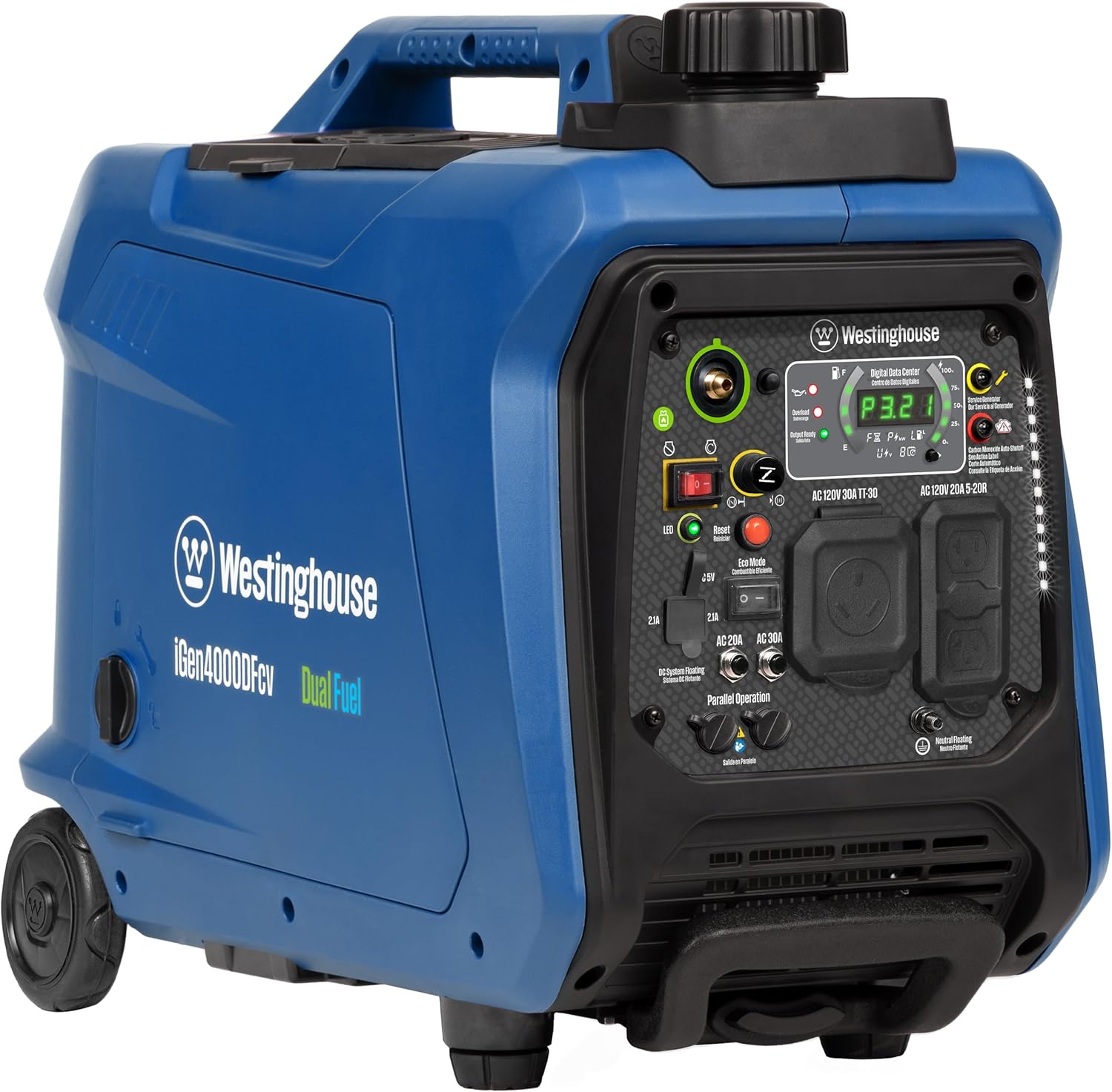
What we like: Westinghouse's iGen4000DFcv adds creature comforts: a telescoping handle, integrated wheels, and an LED data center showing fuel level, output, remaining run time, voltage, and lifetime hours. It's dual-fuel with 4000 peak/3300 rated watts.
Other things to know: The automatic CO shutdown and low-oil protection add safety layers, while economy mode trims fuel use when loads are light. Noise is listed as low as 52 dBA in ideal conditions. If you value a pull-along design and at-a-glance diagnostics, this is an excellent "do-most-things" generator.
- Wheels and suitcase handle for easy transport
- LED data center with run-time estimates
- 4000W peak handles most A/C units
- Bulkier footprint to store
- Control panel can be overwhelming for beginners
Generac GP3300i Inverter

What we like: The GP3300i hits a practical middle ground: more oomph than 2k suitcase units, inverter-clean output for sensitive gear, and an attractive price. Generac's PowerRush™ tech provides extra starting capacity for brief motor surges, handy for fridges and pumps.
Other things to know: COsense monitors carbon monoxide and shuts the engine down if levels become unsafe. If you want an inverter from a household name without crossing into premium pricing, the GP3300i is a solid candidate for outages and weekend trips.
- Clean inverter power from a trusted brand
- PowerRush™ tech handles heavy motor starts
- Economy mode saves fuel
- Gas-only (No propane option)
- Heavier than expected for its size
Pulsar PG2300iS Inverter

What we like: The PG2300iS offers 2300 peak/1800 running watts of inverter-clean power in a compact frame that won't punish your back. It includes two 120V outlets, 12V DC, and a USB-A port for phones and tablets.
Other things to know: Parallel ports let you pair a second unit for bigger days. It's a straightforward, super-portable solution for lights, electronics, and small fridges. As with any 2k-class inverter, starting large compressors is a stretch without soft-start aids. Great budget pick.
- Very lightweight and easy to carry
- Highly affordable price point
- Parallel capability to double power later
- Too small for whole-house A/C
- Gasoline only
DuroMax XP13000EH Dual Fuel Open Frame
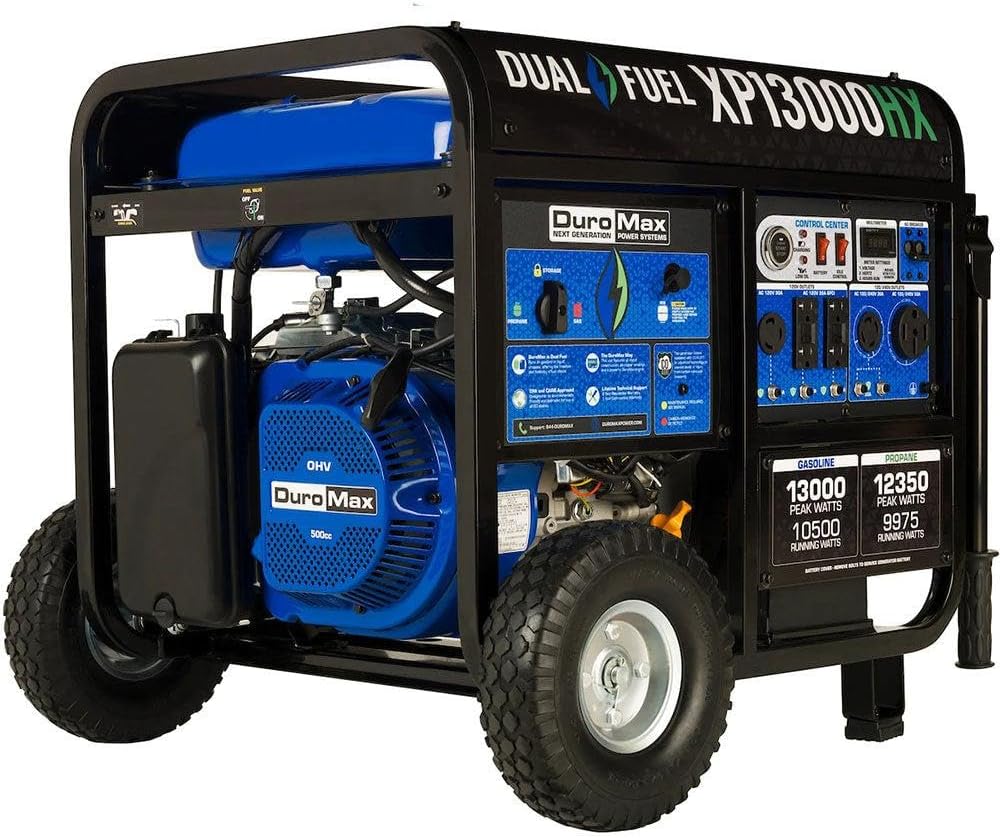
What we like: When you need serious wattage, this open-frame DuroMax delivers: 13,000 starting / 10,500 running watts on gasoline, with dual-fuel flexibility to switch to propane. There's a 50A outlet for direct transfer-switch hookups.
Other things to know: Reality check for tiny homes: it's loud and heavy compared to inverter units, and the power isn't "inverter-clean"—keep sensitive electronics on a quality surge protector. But for well pumps, massive electric heaters, or large A/C loads, this is the "lights on, everything runs" option.
- Massive 13,000W output
- Transfer-switch ready (50A outlet)
- Dual-fuel flexibility
- Loud open-frame design
- Extremely heavy footprint
- Higher THD (not as clean as inverters)
Frequently Asked Questions
What size generator do I need?
If you only need to run essentials (LED lights, a laptop, internet router, and a high-efficiency fridge), a 2,000W to 2,500W inverter generator is plenty. If you need to run a mini-split air conditioner, microwave, or water heater, you will need to step up to a 3,500W to 4,500W unit. Always check the "Starting Watts" requirement on your largest appliances.
Should I choose Gas, Propane, or Battery?
Dual-fuel (Gas/Propane) generators are usually the best combustion choice. Gasoline is easy to find in a pinch, but propane can be stored indefinitely without going bad and burns much cleaner, requiring less engine maintenance. Battery power stations are fantastic because they are silent, fume-free, and recharge via solar, but they have a high upfront cost.
Are inverter generators really quieter?
Yes. Traditional open-frame generators run at a constant 3600 RPM regardless of how much power you are using, making them incredibly loud. Inverter generators throttle their engine speed up and down based on the exact power demand, making them vastly quieter and much more fuel-efficient.
Can I run a generator indoors?
NEVER run a gas or propane generator indoors. Combustion generators produce deadly carbon monoxide and must be run outside, at least 20 feet away from the home, with the exhaust pointing away from doors and windows. The only exception is a battery power station (like an EcoFlow or Bluetti), which produces zero emissions and is 100% safe to use inside your tiny home.
How do I power house circuits safely?
If you want to plug your generator directly into your tiny house to power your wall outlets, you must install a proper Transfer Switch or Generator Interlock Kit. Never "backfeed" power by plugging a generator directly into a dryer or standard wall outlet, as this is illegal, highly dangerous, and can electrocute utility workers.

