

Best Tiny Home Air Conditioners (2026 Guide)
Air conditioning for tiny homes requires efficient units designed for compact spaces. This guide compares portable ACs, window units, mini-splits, and personal cooling solutions to help you choose the right system.
Quick Answer: Our Top Picks
- Top Pick: DELLA Motto Mini-Split - Best efficiency with heating included and smart app control.
- Portable Pick: BLACK+DECKER Portable AC - No permanent installation needed, perfect for renters.
- Off-Grid Pick: EcoFlow Wave 3 - Battery-operable personal AC and heater for off-grid and RV setups.
Why Cooling Strategy Matters in a Tiny Home
Small rooms warm up fast. Cooking, sunlight, and even a couple of guests can push temperatures uncomfortably high. An AC sized perfectly to the space keeps humidity down and protects your finishes, while a poor match can waste power and still leave you sticky.
Because many tiny homes run on limited 30A/50A electrical service or solar power, efficiency and start-up loads matter heavily. We'll walk you through the trade-offs so you can choose with confidence.
📏 BTU & Sizing
Right-size the unit. Oversizing causes "short-cycling" which leaves the air clammy; undersizing means it never catches up. Consider sun exposure, insulation quality, and occupancy.
⚡ Efficiency & Power
SEER/EER ratings signal energy use. Mini-split inverters are typically the most efficient; portables the least. Always check start-up amps if you are running on an off-grid inverter.
💧 Moisture Management
Dehumidification equals comfort. Mini-splits and window units usually beat portable ACs here because they don't create negative air pressure.
🔇 Noise Levels
Small spaces amplify sound. Prioritize quiet indoor fans. Ductless mini-splits excel at silent operation compared to rattling window units.
❄️ AC Types for Tiny Homes
- Ductless Mini-Split (Heat Pump): Highest comfort and efficiency; cools and heats. Requires pro installation, but runs whisper-quiet.
- Portable & Personal ACs: Plug-and-play flexible solutions. Great for targeted cooling in RVs or off-grid setups without heavy power draw.
- Window AC: Good value and better dehumidification than portables. Needs a suitable window and structural support.
- Misting & Fans: Excellent, low-power supplements that boost comfort indoors or on a tiny house patio.
Top Air Conditioners for Tiny Homes
DELLA Motto Series 12,000 BTU Mini-Split

What we like: The DELLA Motto Series 12,000 BTU ductless mini-split delivers both cooling and heating in one quiet package, making it a powerful fit for tiny homes across all seasons. With a 19 SEER efficiency rating, it drastically outperforms window and portable units. The variable-speed inverter compressor ramps output up or down to match demand, rather than loudly cycling on and off.
Other things to know: It features built-in Wi-Fi, allowing you to control your tiny home's climate directly from your smartphone. Installation requires mounting the indoor cassette high on a wall and running the included copper line set to the outdoor condenser. While the physical install is straightforward for avid DIYers, hiring an HVAC tech for vacuuming the lines is recommended for warranty protection.
- Cools, heats, and dehumidifies (inverter heat pump)
- Smart Wi-Fi enabled for app control
- Whisper-quiet indoor operation (as low as 30 dB)
- Professional line vacuuming/commissioning recommended
- Requires permanent installation
EcoFlow Wave 3 Portable Air Conditioner

What we like: The EcoFlow Wave 3 is a breakthrough in off-grid climate control. It is a true, no-installation-required portable air conditioner (6100 BTUs) and heater (6800 BTUs). It is designed to be used in off-grid tiny homes, camper vans, or even tents to quickly cool down a localized personal space without requiring a massive inverter.
Other things to know: It can be plugged into a standard wall outlet, solar panels, or run entirely off an add-on snap-on battery (sold separately) for up to 8 hours. It requires no drainage in cooling mode (self-evaporating) and features smart app controls. It's the ultimate solution for people moving frequently or living without standard 120V grid power.
- Zero installation required; totally portable
- Can run entirely on battery or direct solar power
- Both cools and heats
- Premium price point
- Lower BTU output compared to mounted wall units
BLACK+DECKER Portable AC 14,000 BTU

What we like: This BLACK+DECKER 14,000-BTU-class portable AC is a practical choice when permanent installs aren't possible. It cools, dehumidifies, and circulates air from a compact tower you can roll between rooms. Setup is simple: connect the exhaust hose to the included window kit, plug it into a standard outlet, and you're running within minutes.
Other things to know: For tiny homes, the big win is flexibility — you can store it off-season or shift it to the loft at night. Many users find the self-evaporative design reduces the need to manually drain condensate in normal humidity. Keep the hose run short and seal the window kit carefully for best performance.
- Zero tools required; no permanent wall damage
- 3-in-1 modes (Cool, Fan, Dehumidify)
- Easy to move or store in the winter
- Takes up valuable floor space
- Exhaust hose can radiate heat back into the room
FRIGIDAIRE 12,000 BTU Window AC

What we like: For tiny homes with a suitable sliding or double-hung window opening, this FRIGIDAIRE 12,000 BTU (115V) window AC provides dependable cooling with familiar controls. It includes multi-speed fan settings, a sleep mode, a 24-hour on/off timer, and a remote control.
Other things to know: Window units are often much more efficient than floor-standing portables because the hot condenser sits completely outside the space, preventing negative air pressure issues. The compact cabinet slides into many standard frames. If you're aiming for solid cooling performance without the complexity of a mini-split, this is an incredible value.
- Highly affordable upfront cost
- Does not take up any interior floor space
- Great dehumidification capability
- Occupies a window and blocks natural light
- Installation must be securely sealed to avoid drafts
Klimaire PTAC 12,000 BTU Heat Pump

What we like: The Klimaire PTAC Heat Pump delivers 12,000 BTU of cooling and 10,800 BTU of heat pump heating in a self-contained package designed for standard 42" x 16" wall sleeves. Unlike window units that block your views, this through-wall design sits flush and looks incredibly professional.
Other things to know: The unit includes a 3.5kW backup electric heater for cold snaps when heat pump efficiency drops. What sets this model apart is the Wi-Fi connectivity, allowing you to control your climate from your smartphone before you even arrive home. Installation requires framing out a wall sleeve, making this best for new tiny home builds rather than retrofits.
- Keeps your windows completely free
- Heat pump plus backup electric heating built-in
- Wi-Fi enabled for smart home control
- Requires cutting a massive hole in your wall
- Heavier and bulkier than standard window units
HOMENOTE Outdoor Misting Cooling System

What we like: When your tiny home gets too hot, moving to the patio is usually the first instinct. This misting system attaches directly to your outdoor canopy, pergola, or roof trim. By spraying an ultra-fine water mist into the air, it absorbs heat and instantly drops the surrounding temperature by up to 20°F.
Other things to know: It requires absolutely zero electricity—it runs purely off the pressure of a standard outdoor garden hose or RV spigot hookup. It comes fully pre-assembled, so you simply use the provided clips to hang it up. It is the most cost-effective way to make your outdoor square footage usable during the peak of summer.
- Drops outdoor temperatures significantly
- Extremely affordable and requires no electricity
- Pre-assembled and easy to hang
- Constantly uses a small stream of water
- Less effective in highly humid climates
Dreo Tower Fan 36-inch

What we like: The Dreo 36-inch Tower Fan combines powerful airflow with remarkably quiet operation, making it an ideal companion to your AC or a standalone cooling solution for mild days. Delivering wind speeds up to 25 feet per second through its bladeless design, this compact tower enlivens every corner of your tiny home.
Other things to know: The 90-degree oscillation covers more floor area than traditional fans, and when combined with your AC, it helps distribute cooled air evenly into dead zones (like a loft) for cost-effective comfort. At just 9 pounds with an 11" x 11" footprint, this slim tower tucks perfectly into tight tiny house corners.
- Ultra-quiet operation (as low as 28 dB)
- Takes up almost zero floor space
- Helps drastically reduce AC electrical costs
- Does not actively cool or dehumidify air like an AC
TCL 52-inch Low Profile Ceiling Fan
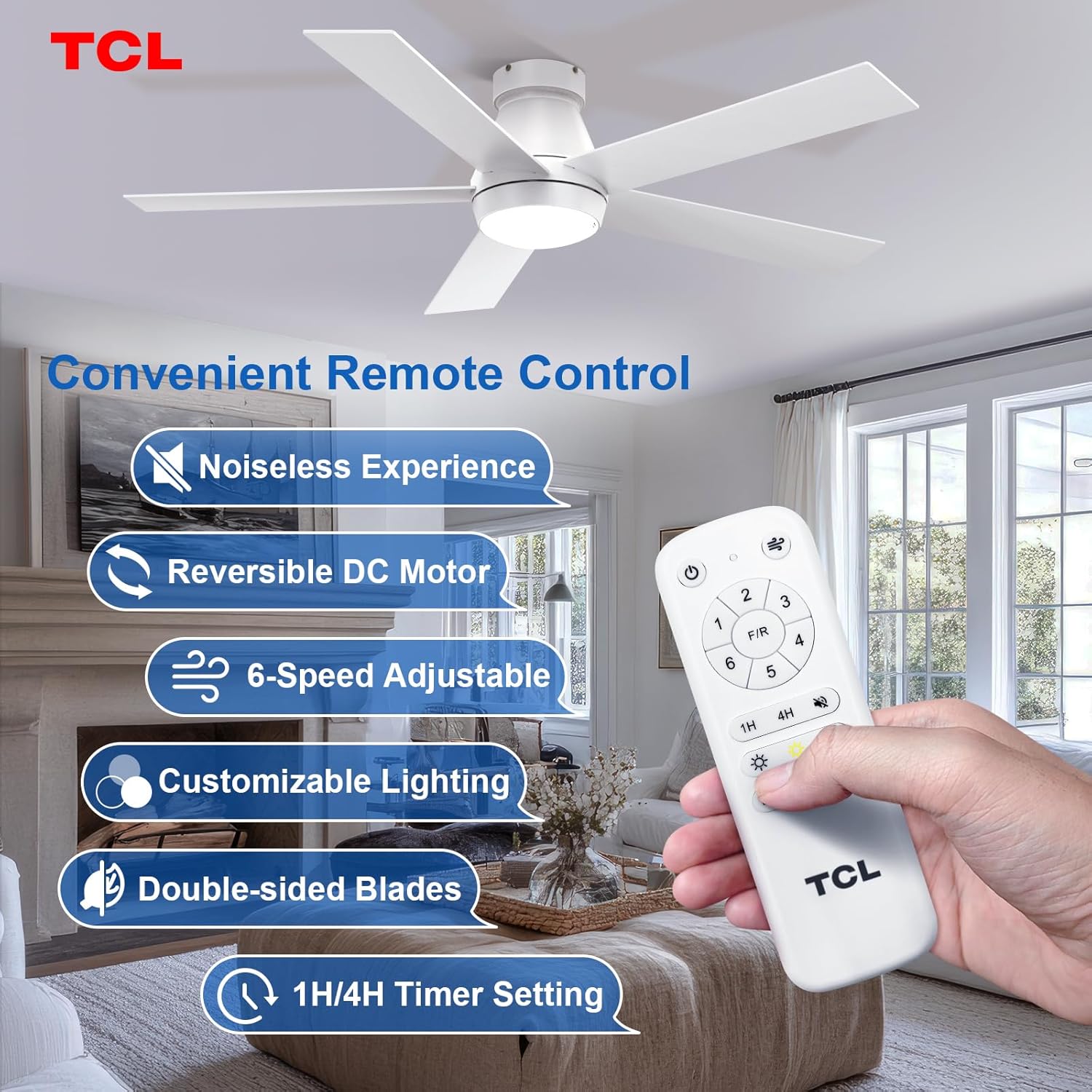
What we like: The TCL 52-inch Low Profile Ceiling Fan is engineered specifically for spaces with limited ceiling height. Standing just 8.26 inches tall, this flush-mount design is ideal for tiny homes, lofts, and compact living areas where every inch of headroom matters.
Other things to know: The energy-efficient DC motor consumes up to 80% less power than traditional AC fan motors while delivering whisper-quiet operation. The integrated 24W LED light panel eliminates the need for separate overhead lighting, a massive advantage in tiny homes. You can also reverse the motor in the winter to push trapped warm air back down from the ceiling.
- Ultra-slim 8.26 inch profile for low ceilings
- DC motor uses extremely low wattage (great for solar)
- Integrated LED lighting with remote
- Requires permanent hardwired ceiling installation
Frequently Asked Questions
How much do tiny home ACs cost?
A standard window unit or portable AC will typically cost between $250 and $450. A high-efficiency ductless mini-split system will cost between $800 and $1,500 for the hardware, plus an additional $500 to $1,000 if you hire a professional for installation and line-set vacuuming.
Any special installation requirements?
Portable ACs just need a window to vent the exhaust hose. Window units require a sturdy window frame and an exterior support bracket so they don't fall. Mini-splits require drilling a 2-3 inch hole through your wall to run the refrigerant lines, and they need a dedicated 15A or 20A circuit on your breaker panel.
What's the typical lifespan of these units?
Portable and window units usually last 5 to 8 years depending on usage and whether filters are kept clean. A well-maintained mini-split system from a reputable brand can easily last 12 to 15 years.
Can ACs help heat the tiny home in winter?
Standard Window ACs and Portable ACs only provide cooling. However, Mini-Splits and PTACs act as "Heat Pumps." By reversing the flow of refrigerant, they extract heat from the outside air and pump it inside. This is the most energy-efficient way to heat a tiny house without using propane or massive electric space heaters.
Join the Community
The Intentional Inbox
Get the latest appliance reviews, builder guides, and tiny house market trends delivered straight to your inbox.
No spam. Just thoughtful tiny living tools.

