

Best Solar Kits for Tiny Houses (2026 Guide)
Solar kits for tiny homes provide energy independence and reduced utility costs. Our guide covers starter kits to complete off-grid systems, helping you choose the right solar solution.
Not Sure What Size System You Need?
Use our free calculator to get precise sizing recommendations for solar panels, batteries, and inverters based on your actual appliances.
Calculate My System SizeQuick Answer: Our Top Picks
- Top Pick: Renogy 400W Starter Kit - A customizable 400W system that handles most basic tiny home needs.
- Budget Pick: Renogy 100W Starter Kit - Perfect for learning the ropes or charging small devices.
- Best for Shade: Renogy Bifacial Panels - Generates up to 30% more power by capturing reflected light.
Why Solar Power is Perfect for Tiny Homes
Solar power and tiny houses are a natural match. The compact size of tiny houses means lower overall energy consumption, making it vastly easier and more affordable to meet your entire electrical needs with solar power. This independence provides the ultimate freedom to live anywhere.
📐 System Sizing
Calculate your daily energy consumption first. Most tiny houses need 400-800W of panels generating 1.5-4kWh daily. Consider peak usage times and seasonal variations in winter sunlight.
⚡ Component Quality
Look for panels with 20+ year warranties, MPPT charge controllers for maximum efficiency, and pure sine wave inverters so you don't fry your sensitive electronics.
🔄 Expandability
Choose modular systems that can grow with your needs. This allows you to start small and add extra panels or battery capacity as your budget allows.
📱 Smart Monitoring
Modern systems offer Bluetooth smartphone monitoring. This data is invaluable for understanding your energy production and preventing battery depletion during cloudy weeks.
☀️ Essential Solar Components
- Charge Controllers: MPPT controllers provide 20-30% better efficiency than cheap PWM controllers. MPPT is always worth the extra cost.
- Batteries: Lithium (LiFePO4) batteries offer longer life, faster charging, and deeper discharge capabilities than traditional lead-acid or AGM batteries.
- Inverters: Pure sine wave inverters are mandatory to convert your battery's DC power into safe AC household power.
Top Solar Kits for Tiny Homes
Renogy 400W 12V Premium Solar Kit

What we like: This 400W kit includes four 100W panels that generate roughly 2kWh daily—plenty for LED lights, a highly efficient refrigerator, device charging, and water pumps. It includes a Rover 40A MPPT charge controller and all the necessary Z-brackets and wiring you need to mount the panels to your roof.
Other things to know: The MPPT controller harvests 20-30% more power than standard PWM controllers through smart voltage tracking. This kit includes a Bluetooth module so you can monitor your power generation directly from the Renogy smartphone app. This kit gives you real off-grid independence with the room to expand by adding an inverter and batteries.
- Includes highly efficient 40A MPPT controller
- Bluetooth monitoring module included
- Provides the perfect base for a tiny house build
- Batteries and AC Inverter are sold separately
Renogy 100W 12V Solar Starter Kit

What we like: This starter kit uses a compact 100W monocrystalline panel that is incredibly affordable. It comes with everything you need to start charging a 12V battery: a 100W panel, a 30A PWM charge controller, mounting Z-brackets, and all necessary cables.
Other things to know: You can expect about 500Wh daily in good sun, enough for LED lights, phone charging, and running a composting toilet fan. The included controller supports AGM, Gel, Flooded, and Lithium batteries. Because it features a 30A controller, you can easily buy more 100W panels later and plug them right into the system as your power needs grow.
- Incredibly affordable entry point to solar
- 30A controller allows you to expand the system later
- Complete kit with all wiring and hardware included
- Included PWM controller is less efficient than MPPT
- 100W is not enough to run a refrigerator
Renogy Bifacial 250W Solar Panel

What we like: Bifacial panels capture sunlight from both sides simultaneously. The front collects direct sun while the transparent back harvests reflected light bouncing off your roof or the ground. In ideal conditions, this generates up to 30% more total power without increasing the panel footprint.
Other things to know: Snow-covered ground reflects 80-90% of sunlight back up, making these panels absolutely perfect for northern climates. To get the maximum benefit, you must mount these raised above your roof or on a ground rack rather than flush-mounted to the surface. Where traditional panels struggle in the winter, these panels thrive.
- Up to 30% extra power from reflected ambient light
- Exceptional winter performance in snowy climates
- Massive 250W output from a single panel
- Needs elevated mounting for the back-side to work properly
- Single panel only (does not include controllers or wiring)
Eco-Worthy 800W 12V Premium Solar Kit

What we like: This 800W kit generates roughly 4kWh daily, which is the sweet spot for full-time tiny house living. It provides enough sustained power to run a highly efficient refrigerator, water pump, lights, laptops, and occasional high-draw appliances like a coffee maker or microwave.
Other things to know: It features eight 100W panels and a massive 60A MPPT charge controller to maximize your daily harvest. All wiring, connectors, Bluetooth module, and mounting hardware are included. If you want grid-free independence for year-round living with modern conveniences, this is the exact kit you need.
- Generates enough power for true full-time off-grid living
- Includes 60A MPPT controller and Bluetooth hub
- Easy to install with all hardware included
- Requires substantial roof space for eight separate panels
Renogy 200W Portable Solar Suitcase
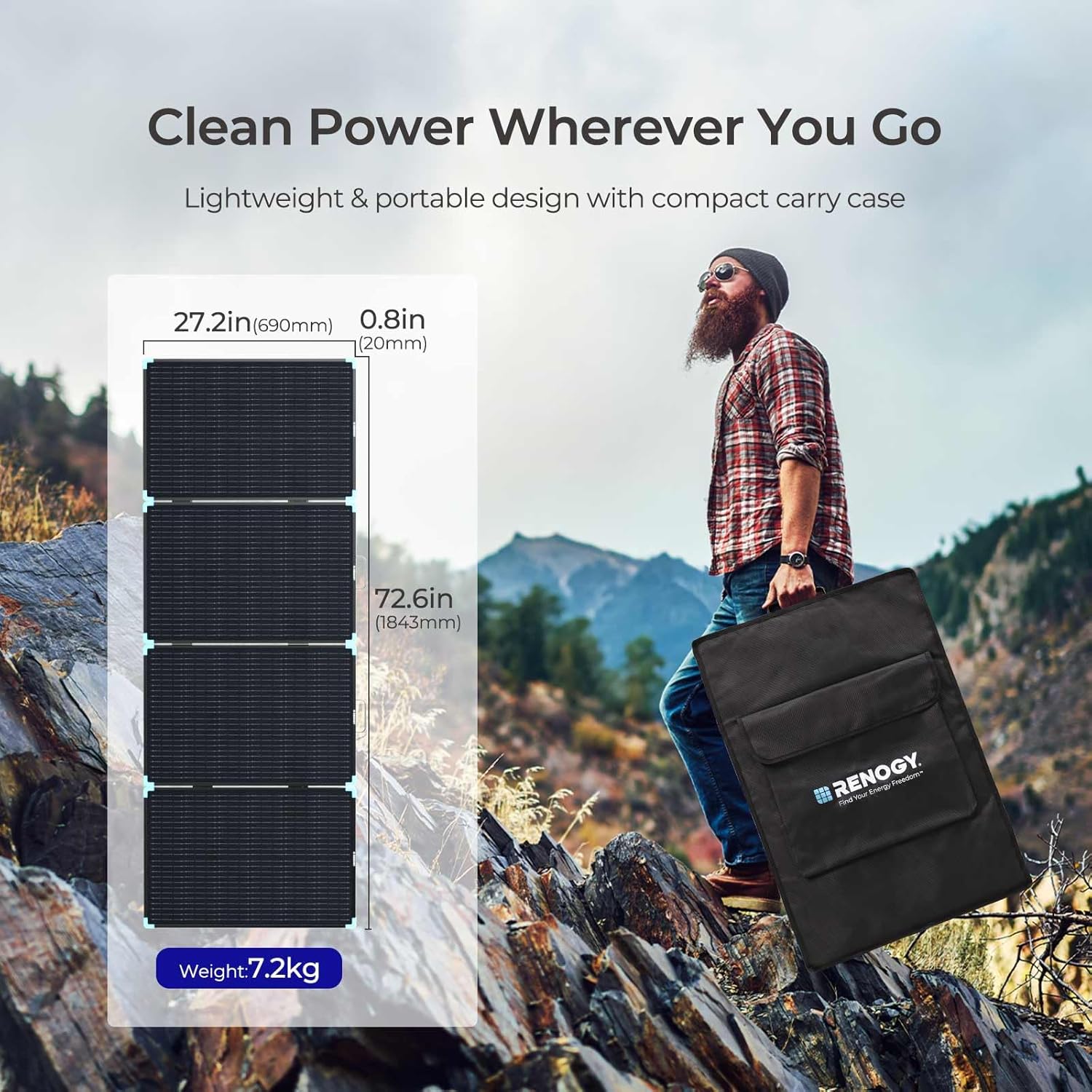
What we like: Not everyone wants to permanently drill massive solar panels into their beautiful tiny house roof. The Renogy 200W Solar Suitcase solves this by folding perfectly in half. When you park your tiny house, you simply unfold the suitcase, set it in the grass facing the sun using the adjustable kickstands, and clip it to your battery.
Other things to know: It features a built-in waterproof 20A Voyager charge controller, so it is entirely plug-and-play. Because it is portable, you can literally move it around your yard throughout the day to chase the sun, resulting in significantly higher efficiency than panels glued flat to a roof.
- Zero installation or roof drilling required
- Can be angled throughout the day for maximum sun exposure
- Includes a built-in waterproof charge controller
- Must be manually set up and packed away
- Vulnerable to theft if left unattended in public areas
Frequently Asked Questions
How much solar power do I need for a tiny house?
The average tiny house running standard appliances (LED lights, a laptop, water pump, and a high-efficiency fridge) requires between 400W and 800W of solar panels. If you intend to run air conditioning, an electric water heater, or an electric oven off grid, you will need a massive system of 2000W to 3000W+.
What's the difference between PWM and MPPT charge controllers?
A charge controller sits between your solar panels and your batteries to prevent overcharging. PWM (Pulse Width Modulation) controllers are cheap, older technology. MPPT (Maximum Power Point Tracking) controllers are newer, smarter, and can pull 20% to 30% more usable power out of your panels. MPPT is always recommended for tiny homes.
Should I choose lithium or AGM batteries for my tiny house?
Lithium (LiFePO4) batteries are significantly superior. While AGM (Lead Acid) batteries are cheaper upfront, you can only discharge them to 50% without damaging them. Lithium batteries can be safely drained to 10% or lower, they weigh half as much, and they last 3 to 5 times longer than AGM batteries.
Can I install solar panels myself on a tiny house?
Yes. Installing basic 12V or 24V "Kits" (like the Renogy systems above) is incredibly DIY-friendly. The kits include pre-crimped MC4 connectors that simply click together. However, once you introduce a large 120V AC Power Inverter and wire it to a standard household breaker box, you should consult an electrician to ensure it is grounded safely.
Can I run air conditioning on solar power in a tiny house?
Yes, but it is incredibly expensive. Running a mini-split AC unit draws massive amounts of continuous power. A standard 400W solar kit will not even come close to running an AC. To run an AC off-grid, you will need a 2000W+ solar array and a massive 10kWh+ Lithium battery bank, which will easily cost over $6,000.
How do I size an inverter for my tiny house?
Your inverter size depends on the "Peak Watts" of all the appliances you plan to run at the exact same time. If you want to run a 1000W microwave and a 1500W hair dryer simultaneously, you need an inverter rated for at least 3000W (always add a 20% safety buffer).
Join the Community
The Intentional Inbox
Get the latest solar reviews, electrical builder guides, and tiny house market trends delivered straight to your inbox.
No spam. Just thoughtful tiny living tools.

