


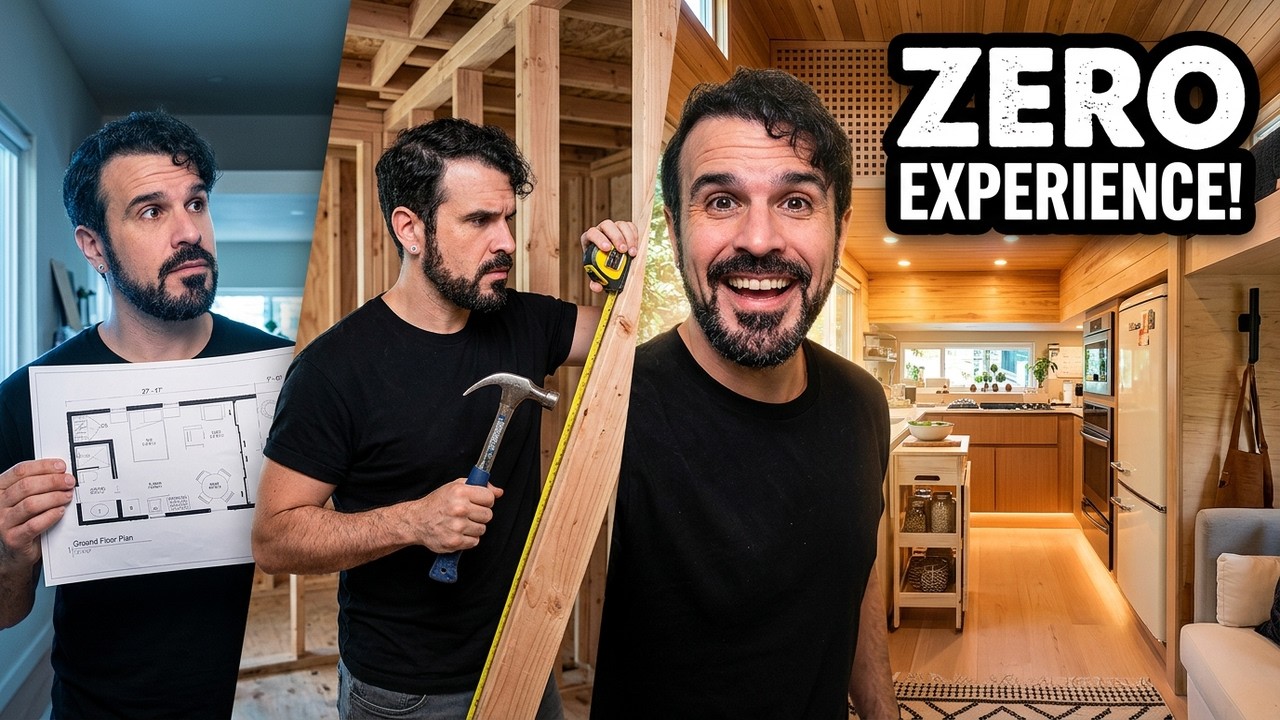
A couple from Jersey City packed up their lives and built a tiny home from scratch in the Pacific Northwest. One of them had never built anything before — her biggest prior project was IKEA furniture. Her partner Sal handled the smart home infrastructure. Her dad came in as lead contractor. The result is one of the most intentional builds I've seen in a while, and there are a handful of decisions in here worth talking through properly.
Watch the full tour first, then read on for what stood out.
Lean on Experience Where You Have It
The team structure here is worth pausing on. She handled architectural and interior design. Sal handled all the technical infrastructure including the smart home system. Her dad came in as the experienced contractor who supervised and worked through every stage of the build. That combination — vision, technical knowledge, and construction experience — is close to ideal for a first-time DIY build.
From what I've seen in this industry, having someone experienced on site consistently makes the difference not just for the quality of the result, but for the builder's own confidence throughout the process. If you're planning a DIY tiny house build and you have someone in your network with real construction experience, lean on them. It's worth far more than almost any other resource you can access.
The Kitchen: Build Around What Actually Matters to You
She works in the food industry and made the kitchen the priority of the build. Her appliances are bigger than what her apartment back east had. I love this for two reasons. First, because it's the right call for her lifestyle. Second, because it illustrates the most important principle in tiny house design: know what matters to you and allocate space accordingly. A tiny house that tries to be a scaled-down version of a conventional home will always feel like something is missing. A tiny house that's genuinely optimised around how one person or couple actually lives can feel like more than enough.
Your tiny house should reflect your life, not someone else's idea of what living small looks like.
The Hallway: Design Psychology That Actually Works
They were inspired by a New Zealand tiny house builder and the specific influence was the hallway — a design that creates a sense of journey from one end of the home to the other. The way she explains the intention is genuinely accurate: moving through distinct spaces, even in a very small footprint, tricks the brain into perceiving more room than actually exists.
A straight open-plan tiny house can feel like a single room regardless of its square footage. When you create a sense of movement and discovery — even subtle transitions between defined areas — the home reads as substantially larger. That's not just an aesthetic preference; it's how spatial perception works. Most first-time builders don't think about this until they're living in the finished home. Tiny Dimensions built it in from the start.
The Bathroom: Small, But Not Compromised
After spending time in other tiny homes before building their own, they realised the bathroom was the room they spent the least time in. They gave it less square footage as a result — a deliberate trade-off rather than an oversight. But they didn't compromise on the finish. The micro-cement walls are something you don't often see in tiny house builds. It's a decorative application that gives surfaces a smooth, modern, almost industrial quality that photographs and lives completely differently from standard tile or paint. More involved to apply, but the result is genuinely distinctive.
The decision-making process here is the thing to take note of. They spent time in other people's homes, identified which spaces they actually used, and allocated square footage accordingly. That's a more rigorous approach than most people bring to their own build.
The Office/Loft: Three-Dimensional Thinking
The office, guest room, and lounge occupy the second floor directly above the bathroom. She mentions almost in passing that the drop ceiling in the bathroom is what allows them to stand upright in the loft above it. That's a detail worth sitting with. The decision to lower the bathroom ceiling wasn't just about that room — it was a three-dimensional planning decision that created usable headroom on the level above.
Most people don't think about how choices on one level affect what's possible on the level above. That kind of spatial thinking during the design phase is what separates a good tiny house build from a genuinely well-engineered one.
The skylight is her favourite feature and it's easy to see why. Natural light from directly above in a loft space changes the entire quality of the room — it opens it up in a way that no side window can replicate. The automatic smart shades that block heat when the sun angles in are the practical complement to that: you get the light when you want it and manage the heat when you don't.
The Bedroom: Knowing What You'd Trade
She chose a queen over a king specifically to preserve the bench area at the foot of the bed — a getting-ready space with a full-length mirror. That's a very deliberate trade-off, and it tells you something important about how to approach a tiny house bedroom: every inch has a function, and you get to decide which functions matter most. She decided that a dedicated getting-ready spot served her daily life better than one extra foot of bed width. That's self-knowledge applied to design.
The Eight Sleep smart mattress is worth highlighting separately. A mattress that regulates its own temperature means they're not running the mini split through the night just to stay comfortable while sleeping. In a small home where energy efficiency compounds meaningfully, that's a genuinely useful investment. The whole home being automated — smart shades throughout, smart mattress, smart home system managed by Sal — makes this one of the more tech-forward tiny house builds I've come across. It demonstrates clearly that tiny living doesn't require giving up comfort or convenience.
The Projector Setup: Multi-Function Done Right
The living room shade doubles as a projector screen. Instead of mounting a television and permanently dedicating wall space to it, the shade does its primary job as a window covering and becomes a cinema screen when needed. That's exactly what good multi-functional design looks like — the secondary function costs nothing extra because the primary function was already there.
The IKEA roller table that tucks into a kitchen corner and wheels out as a dining table is the same principle at a fraction of the cost. You don't need bespoke custom furniture for every solution in a tiny home. Sometimes the most straightforward answer is the right one.
What makes this build stand out overall is how much research went into it before a single piece of framing went up. They spent time in other tiny homes. They found design inspiration from builders on the other side of the world. They identified what mattered to them specifically — a serious kitchen, a tech-integrated home, a hallway that creates space — and built around those priorities deliberately. That process is replicable regardless of budget or experience level, and it's the single biggest factor in whether a tiny house ends up feeling like a home or just a clever engineering exercise.
Join the Community
Build the Home That Fits Your Life
Builds like Tiny Dimensions show what's possible when you start with the right questions. We share weekly insights from inside the tiny house industry — tours, design breakdowns, and what the best builders are actually doing differently.
No spam. Just thoughtful tiny living tools.
.png)

