


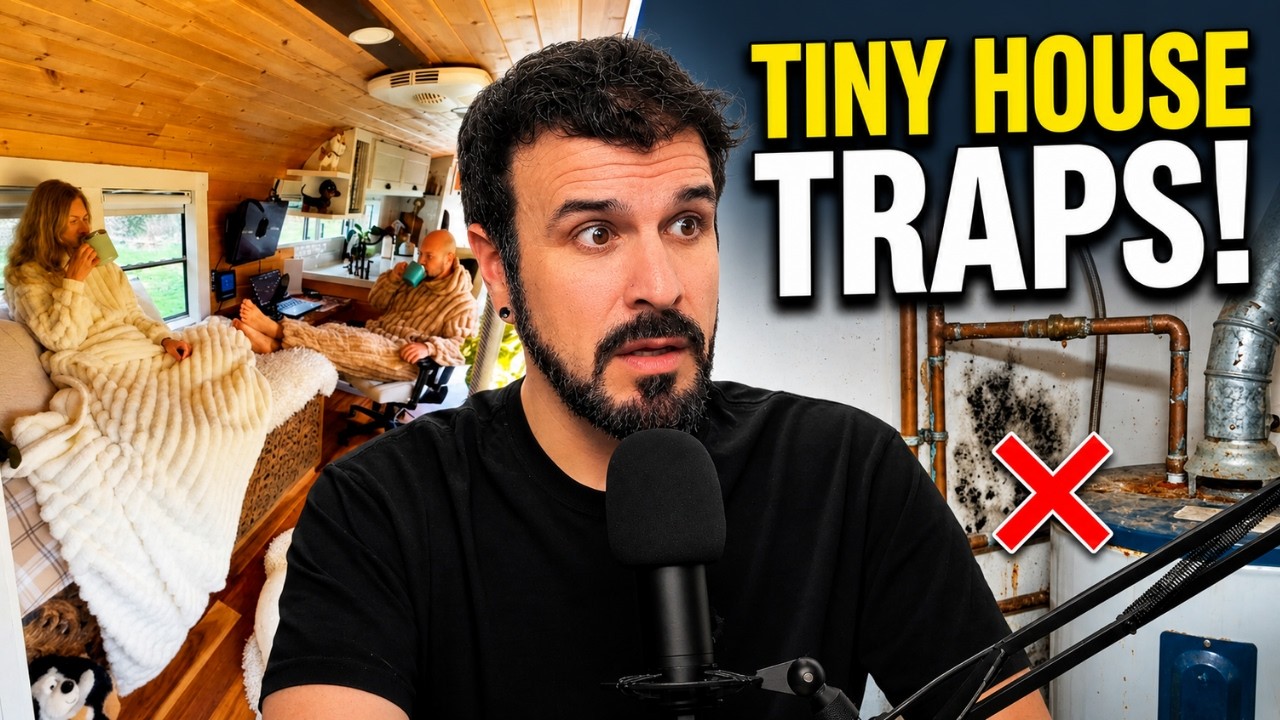
No highlight reels. Six people, six honest accounts of what tiny living actually looks like day to day — the broken fridges, the short showers, the cracked steel, the mold, and the memories that needed to be left behind. And almost every single one of them ends by saying they'd do it all over again. Here's what each of them shared, and what's worth taking from it.
Jack: $22,800, Off-Grid, and Living With Intention
Jack bought his off-grid tiny house for $22,800 in 2021. He gives an honest pros and cons breakdown — the mini fridge means a grocery run every few days, the insulation matters enormously for temperature stability, and a poorly insulated tiny home swings wildly between too hot and too cold. His point on insulation is one I want to make sure anyone planning a build hears clearly: in a small structure, the surface area to volume ratio is so much higher than a conventional home that insulation is not the place to cut costs. A well-insulated tiny house stays comfortable. A poorly insulated one is miserable. Spray foam done right is worth every dollar.
But his biggest pro is the lifestyle itself — living with intention, stopping the mindless accumulation of things, figuring out what you actually want. He says it's worth a million bucks. A lot of people who've made this move would agree with him.
Brisha: Five Reasons She Hates It — She Can Only Find Four
Brisha lives in a 399 square foot tiny home and sets out to list five things she hates. She gets to four — the noise transmission, the five-minute hot water, a mini split that's in the wrong location, and a metal roof that blocked the Wi-Fi — and then runs out because she loves it too much to find a fifth. That is honestly the most credible tiny house review I've seen.
The water heater issue she raises is real and common. A small tank heater in a tiny home means short showers, full stop. The solution that works is a tankless water heater — it heats on demand rather than storing a limited supply. If you're in the same situation, it's worth looking into before you've had another cold shower.
The mini split placement point is also important. She wishes she'd put it in the loft where she sleeps rather than the living area. Mini split placement is one of the most consequential decisions in a tiny house build, and it's worth thinking through carefully before the location is fixed — specifically, think about where you spend most of your time and where you feel heat most acutely. Moving one after the fact is expensive.
The metal roof blocking Wi-Fi is one of those things nobody warns you about. It's solvable — a specific repeater or mesh node handles it — but it's the kind of thing that creates weeks of frustration if you haven't anticipated it.
Ophelia: Five Years in a Converted Bus, and "We Still Choose This Life"
Ophelia and her partner have been living and travelling in a converted bus for five years. The video they share is one of the most honest slices of mobile tiny living out there. In the span of a single trip: a quarter-inch steel bike rack cracks from bad Canadian roads. The fridge dies mid-trip with a full load of groceries. The DC-to-DC charger fuse blows. A deer misses their bus but totals the car in front of them on the highway.
Through all of it, they look at each other and say they still choose this life over anything else. That line is the whole story. Tiny living and mobile living come with real challenges — things break, roads are tough, plans change. The people who are genuinely happy in this life aren't happy because nothing goes wrong. They're happy because of what they get in return. For the right person, that trade-off is worth it.
Misty: Her Only Regret Is Not Doing It Sooner
Misty left a traditional home she'd had built specifically for herself. She loved it. And she still made the move to tiny living. Sitting on her front porch with a cold brew on a Texas afternoon, she tells us her one and only regret is not downsizing sooner — not the square footage she gave up, not the transition, not anything she lost. Just that she waited.
She also makes a point that's worth repeating: this isn't just a lifestyle for single people. She thinks it could work beautifully for a couple, especially heading into retirement and looking to travel. Tiny living has no single demographic. It's for anyone willing to be honest about what they actually need.
Scarlett and Seth: One Year In, Full Damage Report
Scarlett and Seth built their own tiny house on wheels and one year in they give us everything that's gone wrong — the stuff that was their fault and the stuff that wasn't. Their fault: stove sent flying by an unmarked speed bump in Mexico, a car backed into, a tail light taken out by a tree on their anniversary, a water tank that mysteriously detached from the vehicle, a hole punched through the shower wall when someone forgot to push in the composting toilet agitator before sliding it closed, and epoxy on the countertop burned through. Not their fault: ceiling and wall seams cracking, screws pushing through finish surfaces, flickering lights replaced twice, a cabinet latch broken, and a check engine light from a bad O2 sensor.
Their conclusion: all things considered, these are minor issues, and they couldn't be more in love with their home. The ceiling and wall seam cracking is worth noting — this is typically a result of framing movement and settlement in the first year of a mobile build, and it's more cosmetic than structural in most cases. Flexible filler and touch-up paint handle it. The screws pushing through finish surfaces is a related issue — the structure is finding its equilibrium under load and vibration. Both are normal in mobile tiny homes and worth budgeting for as annual maintenance rather than treating as alarming failures.
Ojas: Mold From a Misinstalled Mini Split — Take This One Seriously
This last one is different and I want to handle it with care. Ojas is dealing with a mold situation caused by condensation from an incorrectly installed mini split draining into the wall rather than out of the building. It collected behind cabinets, caused real structural damage, and he's been experiencing respiratory issues for the past couple of months. He's already feeling better with the damaged material removed.
This is a real risk in tiny homes and it's worth talking about plainly. Mini split drain lines need to be installed with the correct downward angle so that condensation flows out of the building rather than pooling at the unit or tracking back into the wall cavity. It's a simple installation detail that causes serious problems when it's wrong, and because the wall cavities in a tiny home are small, moisture damage progresses faster than it would in a larger building.
If you ever notice unexplained respiratory symptoms, a persistent musty smell that wasn't there before, or soft spots developing on walls or floors, take it seriously and get someone in to investigate before it becomes a larger remediation project.
What struck me most about Ojas's video, though, is what he shares at the end. He's not just moving off-grid for practical reasons. He's healing. He's a visual memory person, and this building holds things he needs to leave behind. Building something new with his own hands is part of that process. That's a side of tiny living that doesn't get talked about enough. Sometimes it isn't about minimalism or money or environmental values. Sometimes it's about starting fresh.
What Ties All Six Together
Six people, six different versions of tiny living — a 240 square foot off-grid cabin, a 399 square foot THOW, a converted bus on the road for five years, a Texas tiny home after leaving a traditional house, a self-built mobile home one year in, a tiny house being gutted for mold remediation. Bad insulation, short showers, cracked steel, dead fridges, mold, and memories that needed to be left behind.
And almost every single one of them ends their video saying they'd do it all over again. That's not a coincidence. What comes through in all six accounts is that the challenges are real, the adjustments are real, and the choice to stay is real too. The people who are genuinely happy in small living aren't happy because it's easy. They're happy because it's theirs.
Join the Community
The Real Picture of Tiny Living
No highlight reels — just honest accounts of what small living actually looks like. Subscribe for weekly insights from people already living it.
No spam. Just thoughtful tiny living tools.
.png)

