


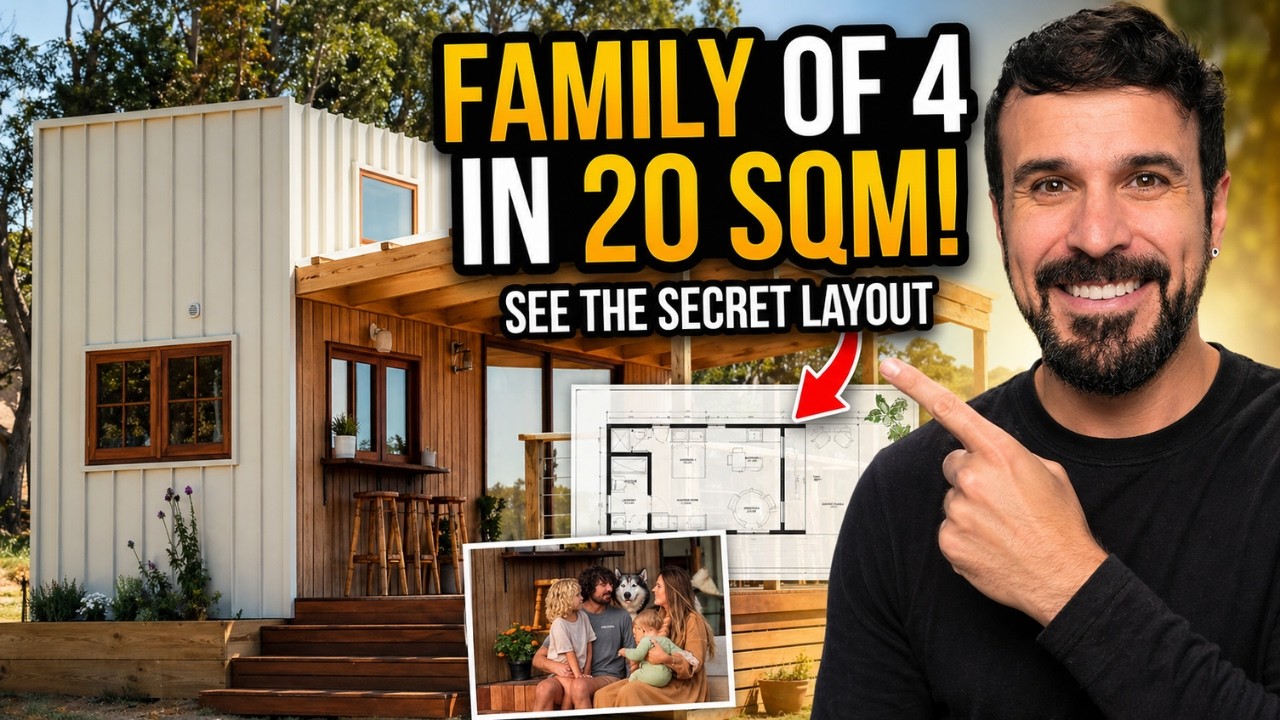
A family of four — two adults, two kids — living off-grid in around 20 square metres. That's roughly 215 square feet. Madison filmed this tour to show how they actually make it work, and the answer is exactly what you'd expect from a well-designed custom build: every decision was made deliberately, and nothing is in there that doesn't earn its place.
Watch the tour, then I'll break down what stood out.
The Kitchen: More Storage Than Her Previous Homes
The kitchen is Madison's favourite space in the house, and the detail that explains why is the large windows that open directly onto a breakfast bar on the deck. It's a simple move that blurs the line between inside and outside — the kitchen doesn't feel like it ends at the wall, it extends to wherever the door swings open. In a space this size, borrowed outdoor volume is one of the most effective tools available.
She also mentions having more cupboard storage than she's had in previous, larger homes. This surprises people until they think it through: when you're designing custom and small, every centimetre is considered from the start. Conventional homes are built to a standard spec where storage is an afterthought. A custom tiny home is the opposite. The storage gets designed in before anything else does.
The built-in lounge with storage underneath is the right call for the same reason. Freestanding furniture that doesn't do double duty is a luxury a 215-square-foot home can't afford. Every piece needs to justify its footprint.
The Bathroom: Composting Toilet, Full Shower, Laundry Under the Stairs
The downstairs bathroom packs composting toilet, shower, and laundry into one compact space — with the washing machine tucked under the stairs rather than occupying its own footprint. That under-stair volume is one of the most consistently underused spaces in tiny house builds, and using it for laundry is one of the cleanest solutions I've seen. The shower is large enough that Madison mentions it could fit all of them if needed, which is a useful benchmark for a family bathroom spec.
There's also an outdoor bath that she's saving for a separate video. That's worth noting as a design philosophy: the outdoor living space is treated as a genuine extension of the home's amenity, not an afterthought.
The Upstairs: Two Private Bedrooms and a Custom Lead Light Window
The upstairs has a standing-height hallway — worth noting because loft hallways that require a crouch are one of the most common daily frustrations in tiny house builds — leading to the main bedroom and their son's room across the hall. Both have full built-in wardrobes.
The main bedroom has a custom-made lead light window that catches the morning sun. It's a small personalisation that makes the space feel like it was built for this specific family rather than assembled from a standard plan — because it was.
Their son's room has a closing door. That detail is the one I'd highlight most from this whole tour. A child who can have their nap undisturbed while the rest of the household functions normally around them — that's not a compromise on tiny living. That's considered design. The room has a double bed and built-in storage, so it's a fully functional private space, not a token gesture toward a children's bedroom.
What This Tour Actually Demonstrates
Tiny living is frequently framed as a lifestyle for singles or couples who've opted out of conventional housing. Madison's home is a useful correction to that framing. A family of four — off-grid, 215 square feet, two separate bedrooms with closable doors, a kitchen with more storage than the houses that came before it. The constraints are real, but so are the solutions. The question isn't whether a family can live in a tiny home. It's whether the home was designed with family life in mind from the start.
Join the Community
Tiny Living Works for Families Too
Tours like Madison's show what's possible when a small home is designed around real family life. We share weekly insights on builds, design, and what actually works in tiny living.
No spam. Just thoughtful tiny living tools.
.png)

